My Research
Interest
Research is my passion, and I am driven by a continuous cycle of exploration, learning, and re-learning, fuelled by deep curiosity. I thrive on questioning existing knowledge, uncovering new perspectives, and refining understanding through rigorous inquiry. This section highlights my scholarly contributions and publications, reflecting my ongoing commitment to advancing knowledge and engaging with impactful research in my areas of expertise.
“Your work is going to fill a large part of your life, and the only way to be truly satisfied is to do what you believe is great work. And the only way to do great work is to love what you do.” – Steve Job-
↓ Research Publications
h-index: 8 (Source: https://scholar.google.co.uk/citations?user=D2HjjOYAAAAJ) Total citations: 154 (since 2021)
- Roslan, N. A., Gutub, A., Rahmat, R. W., Khalid, F., & Udzir, N. I. (2026). Secure bilinear zooming steganography for enhancing QR code image quality and information security. The International Arab Journal of Information Technology, 23(4), 625–638.
DOI: 10.34028/iajit/23/4/1 - Roslan, N. A., Lydia, M. S., & Gutub, A. (2025). Enhancing secure QR code steganography through artificial intelligence: A conceptual framework. Journal of Advanced Research in Applied Sciences and Engineering Technology, 62(4), 224–231.
DOI: 10.37934/araset.62.4.224231 - O’Brien, C. R. K., Roslan, N. A., Murdoch, S. J., Abu-Salma, R., Zytko, D., & Warner, M. (2025). Online dating platform safeguards and self-protection: How dating platforms characterise, respond to, and safeguard against harms. In Proceedings of the Extended Abstracts of the CHI Conference on Human Factors in Computing Systems (pp. 1–8).
DOI: 10.1145/3706599.3719825 - Sun, C., Abdullah, A., Samian, N., & Roslan, N. A. (2025). Steganalysis of adaptive multi-rate speech with unknown embedding rates using multi-scale transformer and multi-task learning mechanism. Journal of Cybersecurity and Privacy, 5(2), Article 29.
DOI: 10.3390/jcp5020029 - Khamis, H., Jantan, A. H., Roslan, N. A., & Abdullah, L. N. (2025). Immersive learning factors using virtual reality in higher education: A systematic literature review (SLR). Environment-Behaviour Proceedings Journal, 10(SI32), 53–62.
DOI: 10.21834/e-bpj.v10iSI32.7053 - Sun, C., Abdullah, A., Samian, N., & Roslan, N. A. (2025). Frame-wise steganalysis based on mask-gating attention and deep residual bilinear interaction mechanisms for low-bit-rate speech streams. Journal of Cybersecurity and Privacy, 5(3), Article 54.
DOI: 10.3390/jcp5030054 - Roslan, N. A., Norowi, N. M., Zabidi, N., Mahmod, R., & Asfarian, A. (2025). Enhancing image-emoji graphical password multi-factor authentication by utilizing single-touch and multi-touch gestures. Journal of Advanced Research in Applied Sciences and Engineering Technology, 62(1), 48–57.
DOI: 10.37934/araset.62.1.4857 - Khamis, H., Khairudin, M., Jantan, A. H., Roslan, N. A., & Abdullah, L. N. (2026). Systematic review of adapting immersive technology in enhancing teaching and learning for students in higher education. Journal of Advanced Research in Applied Sciences and Engineering Technology, 63(1), 130–145.
DOI: 10.37934/araset.63.1.130145Roslan, N. A., Udzir, N. I., Mahmod, R., Zukarnain, Z. A., Ninggal, M. I. H., & Thabit, R. (2020). Character property method for Arabic text steganography with biometric multifactor authentication using liveness detection. Journal of Theoretical and Applied Information Technology, 98(24), 4140–4157.
DOI: Tiada DOI ditemui/diberikan oleh jurnal. - Roslan, N. A., Udzir, N. I., Mahmod, R., & Gutub, A. (2022). Systematic literature review and analysis for Arabic text steganography method practically. Egyptian Informatics Journal, 23(4), 177–191.
DOI: 10.1016/j.eij.2022.10.003 - Thabit, R., Udzir, N. I., Yasin, S. M., Asmawi, A., Roslan, N. A., & Din, R. (2021). A comparative analysis of Arabic text steganography. Applied Sciences, 11(15), Article 6851.
DOI: 10.3390/app11156851 - Roslan, N. A., Mahmod, R., Udzir, N. I., & Zukarnain, Z. A. (2014). Primitive structural method for high-capacity text steganography. Journal of Theoretical and Applied Information Technology, 67(2), 373–383.
DOI: Tiada DOI ditemui/diberikan oleh jurnal.
↓ Books
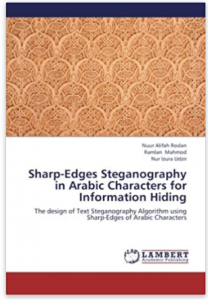
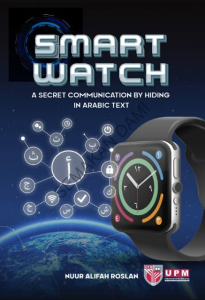

↓Research Grants
2022 – 2024: GP-IPM – Putra Young Initiative Grant (PI, RM 36K)
QR Code Image Manipulation using Bilinear Zooming Steganography for Ownership Protection and Product Authenticity
Technology is rapidly evolving, and smartphones have made QR codes widely used for sharing and accessing information such as tickets, discounts, and product authentication. However, transmitting sensitive data through QR codes raises security and privacy concerns. To address this, our work proposes a secure QR code technique that embeds ownership information into QR code images using a bilinear zooming method. Since QR codes are module-based, the approach allows data to be hidden by manipulating image structures without affecting functionality. The proposed algorithm will be implemented in a mobile application and evaluated through a proof-of-concept to ensure effectiveness in protecting data and verifying ownership.
2021 – 2023: GP-IPS – Putra Graduate Initiative Grant (Co-I, RM18.2K)
A Security Model to Detect Intrusions in Internet of Things using Machine Learning
This research proposes an anomaly-based intrusion detection system using deep reinforcement learning to improve IoT security. The model focuses on identifying normal and abnormal behaviour to detect unknown attacks through feature selection, classification, and training processes. Machine learning and deep learning techniques are used to enhance detection capability and system intelligence. The proposed system will be evaluated based on accuracy, detection speed, and error rates. The aim is to improve early and reliable attack detection in IoT systems.
2022 – 2024: Knowledge Transfer Grant Scheme (Co-I, RM14K)
Entrepreneurial and Digital Skills Development for Youth at Rumah Pakats to Enhance Economic Empowerment and Well-being (SDG 8)
Many young people, particularly in community-based homes such as Rumah Pakats, face limited exposure to these essential skills, which can affect their future economic opportunities. This initiative focuses on developing entrepreneurial mindset and digital competencies among youth to enhance their employability and income-generating potential. Through structured training and practical activities, participants will be equipped with foundational business knowledge and digital skills. The programme aims to support long-term economic empowerment and improve overall well-being, aligned with Sustainable Development Goal 8 on decent work and economic growth.
— Dr. Nuur Alifah Roslan —